Supplementing dryland wheat and irrigated corn with proso millet in drought years

Supplementing dryland wheat and irrigated corn with proso millet in drought years

March 4, 2026Updated: March 4, 2026

Forrest HershbergerBy Forrest Hershberger

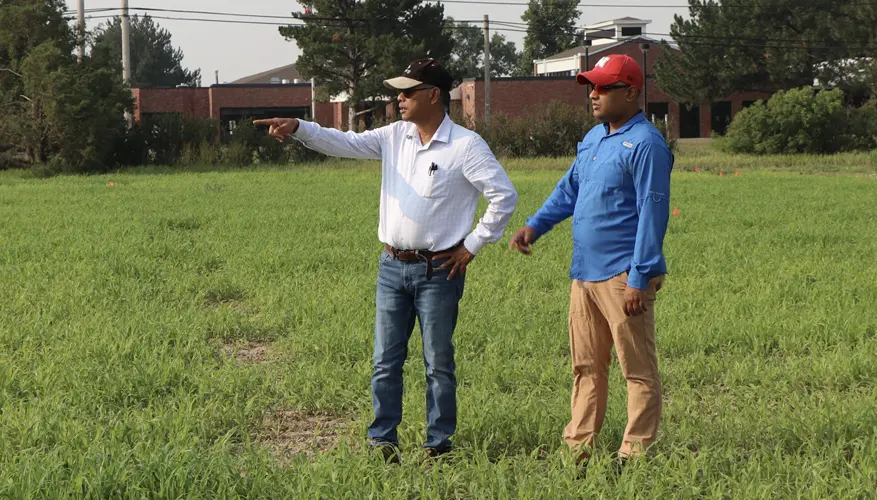
Dipak Santra, Nebraska Extension Alternative Crops Breeding Specialist, and Rituraj Khound, UNL  post-doctoral research associate, discuss the millet growing in a small plot south of the Panhandle Research Extension and Education Center in Scottsbluff. Photo by Chabella Guzman

 (By Rituraj Khound, UNL post-doctoral research associate / Dipak K. Santra, Nebraska Extension Alternative Crops Breeding Specialist)

 The United States High Plains region often experiences low winter precipitation, impacting its crop productivity. Extensive climate analyses indicate that years with significant precipitation deficits, including dry winters, amplify drought severity. As this season’s winter has brought negligible snow thus far, the risk of severe or even extreme drought could be seen in western Nebraska. 

 “This calls for amplified efforts to adopt water-use-efficient alternative crops that can buffer major crops during drier years or in the event of crop failure,” said Rituraj Khound, UNL post-doctoral research associate at the Panhandle Research Extension and Education Center in Scottsbluff.  

 Khound has been researching proso millet, also known as hog millet or millet, which is recognized for its ability to efficiently utilize moisture to produce a considerable yield. Compared to corn and winter wheat, proso millet can produce grain with considerably less water, making it well-suited to water-limited environments. Proso millet’s short growing season allows for more flexible planting windows. Studies show that replacing summer fallow with proso millet significantly improves winter wheat yield.

“Owing to its remarkable agronomic attributes, proso millet has been integral to dryland cropping systems in the High Plains, particularly in eastern Colorado, western Nebraska, and South Dakota,” Khound said. 

 Corn production is primarily concentrated in eastern Nebraska, but western Nebraska maintains substantial irrigated corn acreage, relying heavily on groundwater resources for sustaining production. However, when corn production becomes risky due to low water availability during drier years, it could be a low-water-demanding alternative to preserve water for corn and stabilize farm income. Proso millet is highly versatile for mitigating water-related risks in crop production while providing a highly nutritious alternative to irrigated corn.

Proso millet is an excellent, water-efficient (using 50 percent less water than corn) alternative for supplementing or replacing corn in livestock rations, with comparable energy values for swine and cattle. A grower could plant approximately 25 percent of irrigated corn acres with proso millet to ensure that limited irrigation allocations do not jeopardize corn’s full yield potential.   

 The Alternative Crops Breeding Program at the University of Nebraska-Lincoln (UNL) is a leader in proso millet breeding. Dipak Santra, Nebraska Extension Alternative Crops Breeding Specialist at the Panhandle Research Extension and Education Center, leads the program in Scottsbluff. The program has released the varieties Horizon, Earlybird, Huntsman, Plateau, Sunrise, and Dawn for commercial production in the U.S. Efforts continue to improve the crop for essential traits such as early maturity, grain maturity, and lodging and grain shattering tolerance through a robust breeding scheme, extensive multi-site testing, and germplasm screening for novel genetics.

UNL has developed modern plant breeding tools, including linkage mapping, genome-wide association studies, and UAV-based high-throughput phenotyping, to enhance breeding efficiency. Furthermore, a collection of more than 400 proso millet lines from around the world is being evaluated in field and greenhouse trials to identify the best candidates for future variety development. The Alternative Crops Breeding Lab has recently partnered with several prestigious institutions in an international initiative supported by the International Atomic Energy Agency (IAEA) in Vienna, Austria, to implement mutation breeding to develop novel varieties.

 “Proso millet offers more than diversification. It can offer resilience to both dryland and irrigated cropping systems as a risk-buffering alternative crop,” Khound said. “By integrating millet into corn-based systems and leveraging modern breeding tools, growers in the High Plains can build robust cropping systems that maintain both profitability and productivity.”

###

Nebraska Extension is a Division of the Institute of Agriculture and Natural Resources at the University of Nebraska–Lincoln cooperating with the Counties and the United States Department of Agriculture. Nebraska Extension educational programs abide with the nondiscrimination policies of the University of Nebraska–Lincoln and the United States Department of Agriculture.